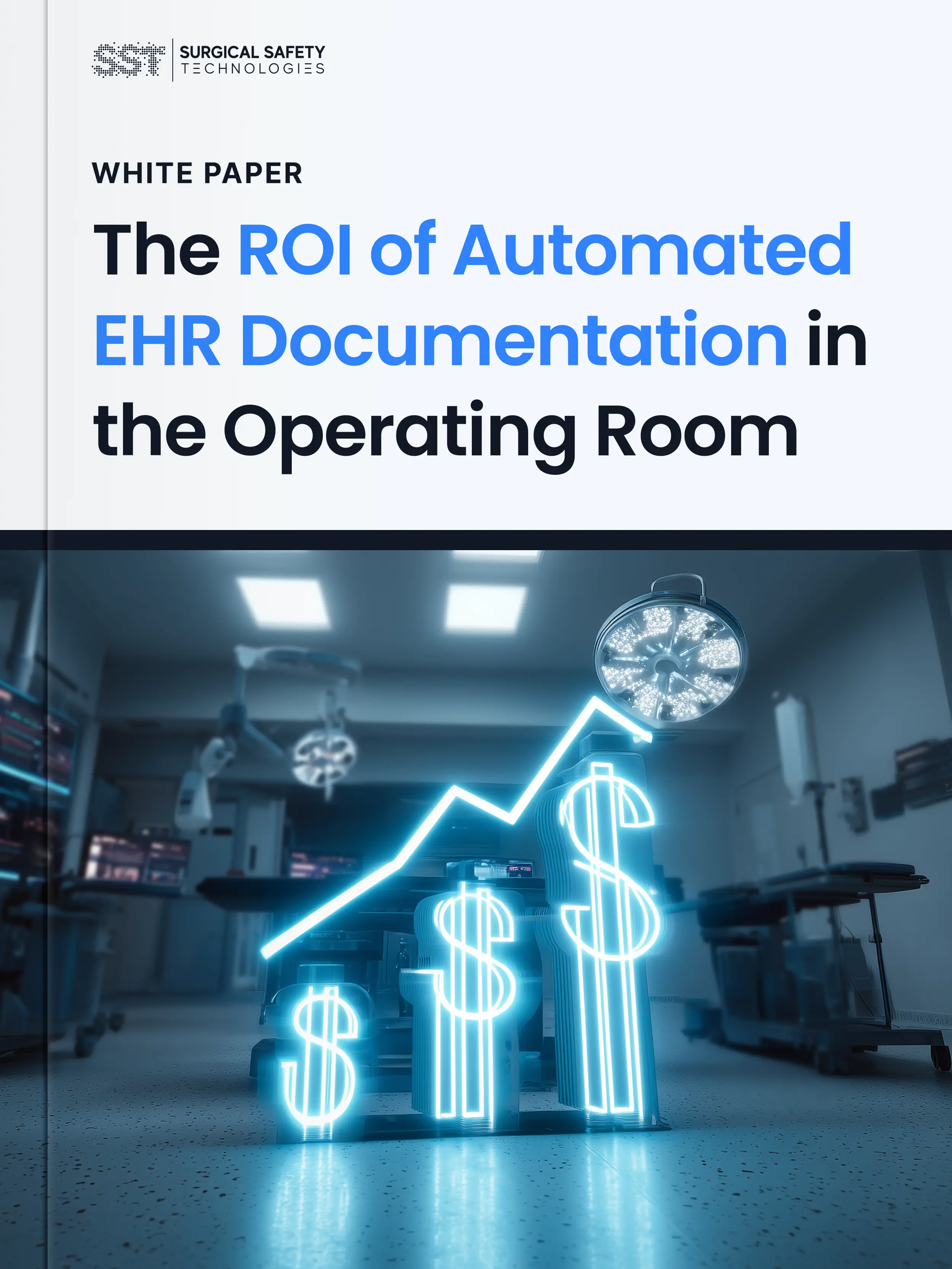
White Paper
The Hidden Cost of Manual Timestamp Entry in the EHR
Discover how manual timestamp entry in the EHR drives inefficiencies and hidden costs, and how automation boosts OR performance.

Every minute counts in the operating room. Yet across hospitals worldwide, a surprising inefficiency continues to drain productivity, predictability, and profit: manual timestamp entry in the Electronic Health Record (EHR).
This white paper exposes the hidden friction behind what seems like a minor administrative task — manually entering “wheels in” and “wheels out” times. The research, based on over 170,000 surgical cases, reveals that even a one-minute delay in documentation can cascade into lost surgical capacity, extended turnover times, and downstream workflow breakdowns that impact every corner of perioperative operations.
Readers will discover:
How delayed timestamp entry quietly undermines team coordination, scheduling accuracy, and case throughput.
Quantitative data showing how small documentation gaps accumulate into hours of lost surgical time per room per year.
The human toll of manual processes, from cognitive fatigue to clinician burnout — and how automation can restore focus to patient care.
A look ahead to AI-powered ambient sensing that captures workflow events in real time, eliminating latency and creating a frictionless OR environment.
The findings challenge healthcare leaders to rethink what “efficiency” means in the surgical setting — and why precision in data must match the precision of the surgery itself.
Access the full white paper to explore the data, see real-world case analyses, and understand how automated timestamping transforms both workflow and financial performance.
RESOURCES