PATIENT SAFETY
Surgical Safety Improvement Requires Strong Systems: Key Insights from the IHI
The IHI President and CEO shares why system design, technology, and psychological safety are essential to surgical safety improvement.

Surgical Safety Technologies
How the Institute for Healthcare Improvement Supports Surgical Safety Improvement Nationwide
For more than three decades, the Institute for Healthcare Improvement (IHI) has partnered with health systems across the United States to advance surgical safety improvement and elevate the quality and reliability of care. From large academic medical centers to community hospitals, the IHI works alongside organizations to strengthen systems, culture, and leadership - recognizing that sustainable improvement depends on how care is designed and supported, not just how it is delivered.
The IHI’s influence spans education, research, and hands-on improvement work. Their frameworks have shaped national conversations around patient safety, high reliability, and system design, particularly in high-risk environments like the operating room. When the IHI leaders speak about surgical safety improvement, their insights carry weight because they are grounded in evidence and real-world operational experience.
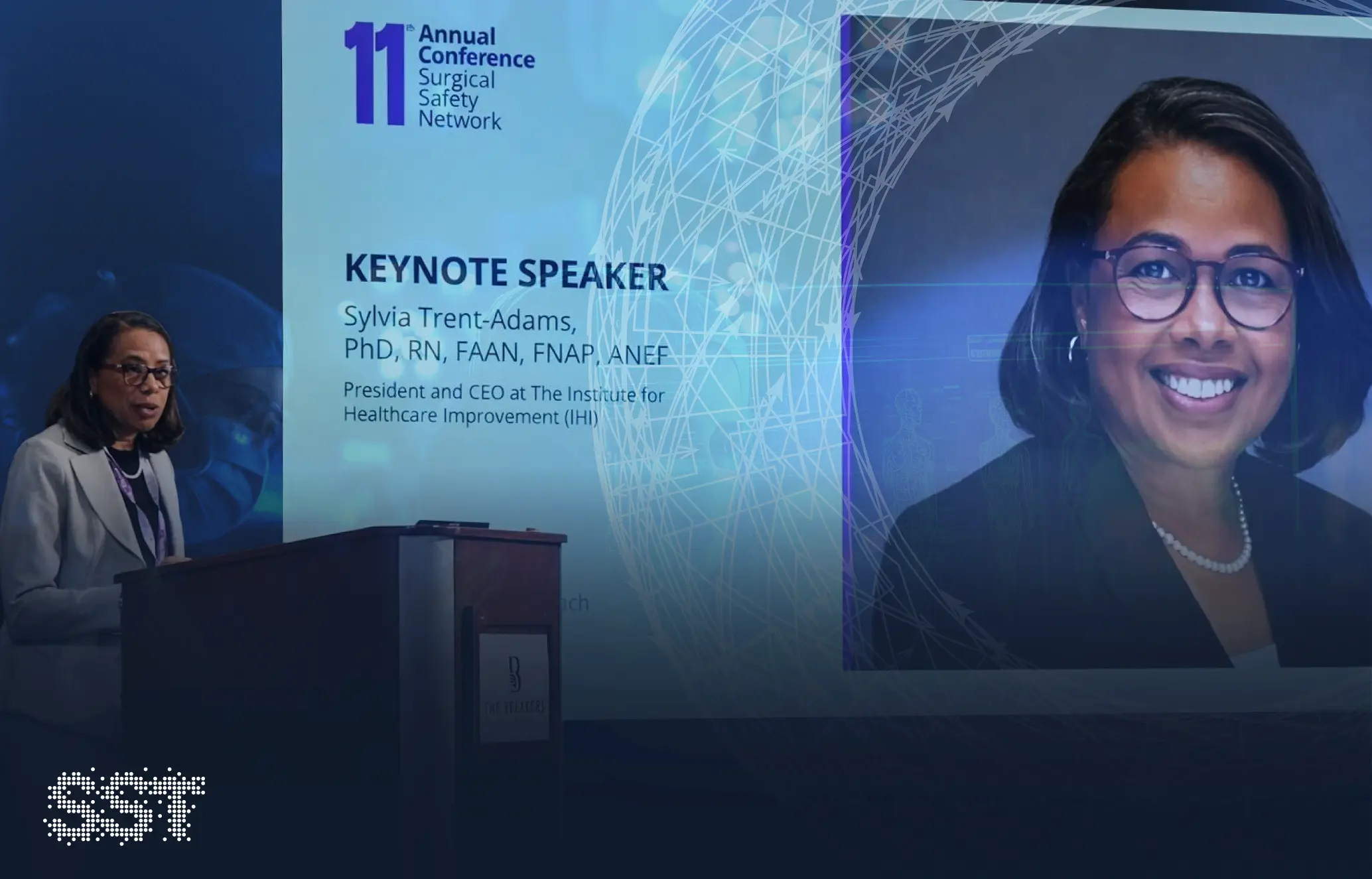
That credibility was on full display when Syliva Trent-Adams, President and CEO of the IHI, joined our most recent Surgical Safety Network (SSN) Conference to reinforce the urgency of addressing surgical safety challenges at the system level.
A Shared Commitment to Surgical Safety Improvement Through Better Systems
At Surgical Safety Technologies (SST), our mission closely aligns with the IHI’s long-standing belief that surgical safety improvement is achieved through intentional system design. While individual clinical expertise is essential, consistent safety and quality outcomes depend on whether the surrounding systems support good decisions - especially under pressure.
The IHI has long emphasized that outcomes reflect the systems in which clinicians operate. SST was founded on that same principle, with a focus on making care delivery more visible inside the operating room. By capturing objective audiovisual data and applying advanced analytics, SST helps organizations understand how surgical care is actually delivered, where systems break down, and how performance can be improved at scale.
This shared philosophy - improving surgical safety by strengthening systems rather than assigning blame - was a recurring theme throughout Dr. Trent-Adams' remarks and resonated strongly with the clinical, operational, and executive leaders in attendance.
Why Technology Is Central to Surgical Safety Improvement
A key message from the presentation was that healthcare organizations can no longer rely solely on retrospective reports or self-reported data to drive meaningful surgical safety improvement. The IHI views technology as a critical enabler of safer care - particularly tools that provide objective insight into how systems function during routine operations and high-stress situations.
Dr. Trent-Adams highlighted how limited visibility into care delivery forces teams to compensate for gaps they cannot see. When information isn’t consistently shared, clinicians are left making autonomous decisions without full situational awareness. Over time, these invisible system gaps increase variability, risk, and burnout.
Technology that expands visibility across complex surgical environments helps close those gaps. When teams and leaders can clearly see patterns, pressures, and failure points, they are better equipped to design systems that actively support surgical safety improvement.
Key Takeaways on Surgical Safety Improvement from the IHI at SSN 2026
One of the most powerful themes of the presentation at SSN 2026 was the importance of psychological safety in healthcare. Sustainable surgical safety improvement requires environments where team members feel safe speaking up, sharing concerns, and identifying system weaknesses without fear of blame. Without psychological safety, critical information remains hidden and improvement efforts stall.
Another central takeaway was the reminder that systems are perfectly designed to produce the outcomes they deliver. If surgical outcomes are inconsistent or unsafe, it is not a reflection of individual effort - it is evidence that the system itself is failing to support reliable performance. Poorly designed systems inevitably lead to poor patient outcomes.
Finally, Dr. Trent-Adams emphasized that true safety depends on how well systems hold when pressure is high. Surgical safety improvement is tested not during ideal conditions, but during moments of complexity, urgency, and stress. Strong systems absorb pressure and guide good decisions; weak systems fracture and leave individuals to compensate in unsafe ways.
Continue the Conversation on Surgical Safety Improvement at SSN 2027
The presence of the IHI at our most recent SSN Annual Conference underscored a growing consensus across healthcare: advancing surgical safety improvement requires system-level insight, cultural support, and the intelligent use of technology.
The next annual conference - SSN 2027 - will continue this work by bringing together clinical, operational, and executive leaders to share evidence-based strategies, real-world lessons, and proven approaches to improving safety in the operating room.
If you are committed to advancing surgical safety improvement and building systems that support clinicians and protect patients when it matters most, we invite you to request information about attending SSN 2027 and join the leaders shaping the future of surgical care.